Author: Trailers For All

  • How I Stopped Losing Time and Money: A Practical Plan for Trailer Maintenance

    How I Stopped Losing Time and Money: A Practical Plan for Trailer Maintenance

    How I Stopped Losing Time and Money: A Practical Plan for Trailer Maintenance

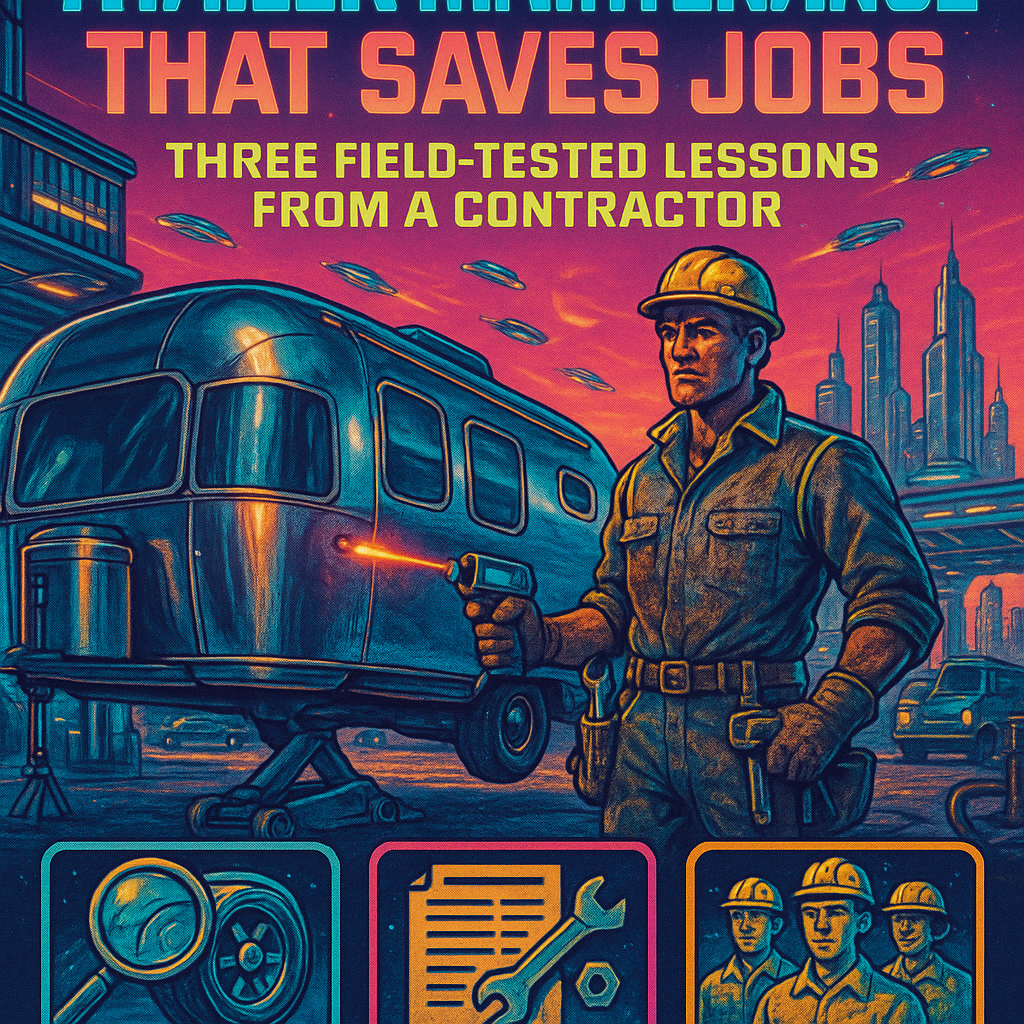
    I learned the hard way that neglecting trailer maintenance costs more than parts. One spring morning I showed up to a job with a trailer that wouldn’t roll because a bearing had seized overnight. The crew waited two hours. The client watched. We lost the day’s margin and a chunk of goodwill.
    Trailer maintenance starts with a plan you can actually follow. In this piece I’ll walk through the exact checks, routines, and simple systems I use on a small fleet of work trailers so downtime drops and crews stay productive. The primary keyword — trailer maintenance — appears here because it’s the core of what makes a mobile operation reliable.

    Start with a small, daily checklist that runs in the first 10 minutes

    If you try to inspect everything deeply every morning it will fail. Instead, build a short morning routine that any team member can run in under 10 minutes.
    Check tire pressure and look for sidewall damage. Low pressure causes heat build-up and premature wear. Rotate any tire concerns into a next-step slot on your workboard.
    Walk the lights and wiring. A single loose connector is a safety risk and a compliance risk. Fix minor wiring issues immediately or tag the trailer out until fixed.
    Listen to bearings and brakes during a short pull. Strange sounds on a slow drive often show problems before parts fail.
    Record the checks. A photo or a single line in a shared note keeps the team honest. When you train new hires, the checklist becomes their best friend.

    Scheduled inspections: weekly, monthly, and seasonal actions

    Daily checks stop surprises. Scheduled inspections stop failures.
    Weekly: clean the coupler, inspect safety chains, and grease the hinge points. These are fast wins that prevent bigger failures.
    Monthly: lift the trailer and inspect wheel bearings, check the brake adjustment and hub temperature after a short run, and tighten wheel studs to spec. Bearings run hot before they fail. Catching heat early avoids a seized hub.
    Seasonal: before winter and before the busy season, replace worn tires, inspect suspension hangers, check frame welds for fatigue, and service electric controllers and hydraulic systems if fitted. Salt and heavy loads stress welds and fasteners.
    Document every inspection. Over time the logs give you patterns: a certain axle wears faster, or a route produces more wiring failures. Patterns let you fix root causes, not repeat symptoms.

    How to prioritize repairs

    If you only have one mechanic and three trailers, prioritize safety and uptime. Brakes, lights, and couplers rank highest. Next come tires and bearings. Cosmetic issues and nonessential accessories come last.
    When a trailer returns from the field, triage it. If it has an urgent mechanical issue, make parts and labor the top line item for the next day. If it’s a recurring nuisance, investigate the operating pattern that causes it.

    Parts, spares, and the inventory rule that saved me money

    Carrying every spare part is wasteful. Carrying none invites long downtime. I use a simple inventory rule: keep spares for the items that cause over 80% of roadside repairs.
    For me that meant an extra coupler latch, two spare tires, a hub grease pack, and a pair of replacement light connectors. Those items cover the majority of fast repairs that get trailers back on the road within an hour.
    Tag spares with the trailer ID they most often serve. When you install a spare, log it. The small administrative overhead pays off when you track how often each part moves and when to reorder.

    Crew training, predictable handoffs, and ownership

    Create simple ownership. Assign each trailer to a primary and a backup tech. Ownership does not mean the owner pays for parts. It means they perform the weekly check, agree to the log entries, and escalate issues.
    Train crews on one skill at a time. Teach tire changing one day, then light troubleshooting the next. Small, focused training sessions stick.
    Use clear handoffs. When a crew finishes an assignment, they record any abnormal observations and snap a photo of the trailer’s tires, lights, and load distribution. The tech on deck reviews the notes before the next job.
    A culture of ownership reduces finger-pointing. It also creates pride. Trailers that look cared for stay in service longer.

    Use outside resources where they help, not to replace judgment

    I read short, practical guides and occasionally follow an industry blog for technical tips. When I need structured thinking about team development I reference proven frameworks on leadership to shape how I assign responsibility and measure results (see leadership). When I need to bring more customers to slow months, I study basic online strategies and a local resource for trailer-focused search work on seo.
    Those links are reference points. I still base decisions on what I see in inspections, the patterns in my logs, and the crew’s feedback.

    Closing: build a system you will keep using

    The obvious truth is this: good trailer maintenance does not require heroic action. It requires a durable system that fits your operation. Start with a ten-minute daily checklist, add weekly and monthly inspections, carry targeted spares, and make one person responsible for each trailer.
    Do that and you will stop losing days to preventable failure. Your crew will trust your gear. Your customers will notice the difference. You will run a leaner, quieter operation that keeps moving.
  • How I Stopped Losing Jobs to Bad Planning: Real lessons in trailer operations

    How I Stopped Losing Jobs to Bad Planning: Real lessons in trailer operations

    How I Stopped Losing Jobs to Bad Planning: Real lessons in trailer operations

    I learned the hard way that trailer operations break down long before the wheels do. On a cold Monday I showed up at a remote job only to find the trailer’s liftgate dead, a missing spare, and a single technician trying to juggle tools and paperwork. That morning cost us a day of labor, two unhappy subcontractors, and a customer who wondered if we could handle larger work.
    This article lays out five practical lessons I use now to keep trailers rolling, crews productive, and costs from bleeding out on site. These are field-tested, not theoretical. I write from the vantage of someone who has patched flooring in a rainstorm, rewired lights at midnight, and rebuilt a parts inventory on a shoestring.

    Frame the real problem: trailer operations fail at the edges

    Most operators focus on big-ticket failures: blown axles, cracked frames, electrical fires. Those matter. I found smaller, predictable issues do far more damage to schedules and margins. Missing fasteners. Uncharged batteries for gate motors. A single incorrect coupling size.
    Treat the trailer as a system that supports work, not the other way around. When the system fails at any peripheral point, the job bends to the failure and costs spike.

    Quick triage that saves a morning

    When you arrive on site with a problem, use a three-step triage: assess, stabilize, and adapt. Assess what stops work now. Stabilize using what’s on the trailer. Adapt the day plan to keep crews productive while you fix the trailer.
    This approach keeps downtime measured in hours instead of a full day.

    Build simple checklists that your crew will actually use

    Checklists fail when they become long, bureaucratic, or unrealistic. I switched to two short, repeatable lists: a daily start checklist and a pre-departure checklist. Each fits on a laminated card tucked into the glove compartment.
    The start checklist covers battery state, lights, tires, hitch tightness, and basic tool inventory. The pre-departure checklist adds straps, spare parts, paperwork, and gate function. It takes five minutes when the crew is together and removes most surprises.

    Keep checklists actionable and measurable

    Write items that someone can verify visually or by a one-word response. For example: “Battery voltage >12.4V” or “Gate lifts under load.” Replace vague items like “check lights” with “driver-side tail light working.” That clarity drives consistent follow-through.

    Inventory the few parts that keep you moving

    You cannot carry everything. You must carry the right small stock that prevents calls home. Early in my career I carried every bolt size and paid for it in wasted space and weight. I now carry a compact kit: common fasteners, a couple of hydraulic fittings, two spare fuses of each standard size, one spare tire, a gate motor fuse, and a lightweight tool multi-kit.
    Treat that kit as mission critical. I audit it weekly and after every job that used parts. If the kit runs empty, the trailer’s readiness drops immediately.

    Train the crew to fix at the scene, not just report problems

    Training does not need to be fancy. It needs to be practical and repeated. I run 30-minute monthly sessions focused on troubleshooting the trailer as a tool. One month we teach electrical troubleshooting. Another month we practice emergency jack and tire changes under time pressure.
    Make the training measurable. Two technicians should be able to change a fuse and swap a strap in under ten minutes. If they can’t, adjust the training until they can.

    Plan logistics like a small operation, not a hobby

    The mistake I made was treating trailer logistics like an afterthought. I scheduled jobs without checking trailer readiness, then blamed weather or subcontractors when jobs slipped. Focus logistics on three questions: which trailer for which job, what parts and tools must travel with it, and who is responsible for post-job reset.
    Have one person own trailer readiness for the week. That ownership creates accountability without being bureaucratic. When one person signs off, everyone knows the trailer left the yard ready to work.

    Use process to reduce personality risk

    If only one high-performing tech knows how to fix a certain failure, you have a bottleneck. Cross-train so two or three people can handle key repairs. That redundancy protects schedules and reduces last-minute overtime.

    Mid-article resources that helped me think differently

    Two short reads changed how I manage crews and online presence. A practical primer on practical field leadership shifted how I assign responsibility and mentor technicians. You can explore ideas about leadership here: leadership.
    Another resource helped me think about how customers find local trailer services and how content choices affect that visibility. If you manage your business’s website, that background on search and content strategy is useful without being technical. Learn more about seo here: seo.

    Close the loop: post-job reset is a discipline, not a chore

    The single biggest change I made was enforcing post-job reset. After a job, the crew does a five-minute wrap: clean the deck, stow loose tools, top fluid levels if needed, restock the parts kit, and record anything that needs a shop fix. The trailer leaves the site closer to ready than it arrived.
    That discipline costs five minutes a day and saves hours down the line. It also creates a simple feedback loop. If a part failed on the job, the form records it and the item gets replaced before the next dispatch.

    Final insight: treat trailers as operating assets first

    A trailer is a mobile workbench. When you treat it that way, planning changes. You invest in checklists, small spare inventories, and short practical training sessions. You create simple ownership and a reset discipline that keeps work moving. Those changes do not require big budgets. They require routine and intentionality.
    When you leave the yard with a ready trailer, you leave with a predictable day. A predictable day keeps crews focused, customers calm, and costs down. That is how trailer operations stop being an ongoing problem and start being a competitive advantage.
  • How One Spring Breakdown Taught Me the Real Rules of Trailer Maintenance

    How One Spring Breakdown Taught Me the Real Rules of Trailer Maintenance

    How One Spring Breakdown Taught Me the Real Rules of Trailer Maintenance

    I remember the morning my crew called from a highway turnaround: the trailer had lost a wheel bearing on a two-day commercial job. In the first hundred words I want to be clear — trailer maintenance is not a weekend task you squeeze in. It is the discipline that keeps equipment, schedules, and crews on the road. If you treat maintenance like an afterthought you will pay with delay, safety risk, and higher long-term costs.

    Diagnose the problem where it starts: daily checks that save shops and jobsites

    We used to ignore the two-minute walk-around because everyone was busy. That stopped the day a snapped safety chain left an unsecured load sliding on the highway. A short, consistent daily check prevents small failures from becoming roadside emergencies.
    Start with a scripted walk-around and keep it simple. Inspect tires for cuts and correct pressure. Verify lights and wiring are secure. Check hitch, coupler, safety chains, and breakaway systems for corrosion or play. Listen for unusual noises during the first pull of the day. Record anything abnormal and prioritize fixes.
    A written habit turns maintenance from guesswork into repeatable practice. If your team treats inspections like optional chores, assign responsibility, set a time, and make the findings visible. Over time the small catches compound into fewer big failures.

    Plan maintenance around usage, not the calendar: a usage-based approach

    Most shops work by calendar because it looks organized on paper. But trailers wear by load, road, and climate. A construction trailer that spends a season hauling gravel will need service sooner than a demo trailer that moves occasionally.
    Track miles, loaded hours, and type of work. Match service intervals to real use. For heavily loaded or off-road work shorten intervals for bearings, brakes, and suspension. For long highway hauls check wheel end components more often. Use a simple log in a shared file or whiteboard. The point is accuracy. Replace guesswork with measured triggers and you will reduce unscheduled downtime.

    Fix root causes, not symptoms: how to stop repeating the same repairs

    When a part fails, technicians often replace it and move on. That produces return visits. I learned to ask three questions before ordering parts: what failed, why did it fail, and what will stop it from failing again?
    If bearings overheat, inspect seals, check grease type and quantity, and evaluate hub runout. If lights corrode repeatedly, question the mounting method and wiring routing. Sometimes a slightly larger bracket or a routed loom makes all the difference.
    Document the fix and the cause. Build a short troubleshooting note into your repair orders. That knowledge spreads through the team and prevents the same downtime from recurring.

    Build crew capability through small, practical leadership moves

    Routine maintenance depends on the people doing it. Training does not require big budgets. Short, focused sessions that show how to use a grease gun properly or how to check brake adjustment deliver outsized returns.
    Leadership matters. When a foreman models the walk-around, the crew follows. If you want better results, pair a junior tech with a veteran for two weeks, then rotate. Create brief job aids that live in the trailer toolbox.
    If you need frameworks for practical crew development, look for free resources on compact leadership topics that translate to the shop floor. Linking non-promotional material about leadership can help teams adopt clear habits and sustain them. For example, I’ve used articles on day-to-day leadership techniques that helped our foremen turn checks into habits.

    Make data work without drowning in it: measure the few numbers that matter

    You do not need a fancy system to manage trailer uptime. Track three metrics and meet on them weekly. I recommend: percentage of scheduled maintenance completed on time, number of roadside failures month-to-month, and average time-to-repair for unscheduled events.
    Keep the metrics visible. A whiteboard in the shop or a shared spreadsheet will do. If a metric drifts, ask what changed in operations. Often a new driver, a season of wet weather, or a subcontractor with different loading habits explains the shift.
    If you want to attract more customers or make your business easier to find, basic seo work on your site makes the difference between being invisible and being the go-to local operator. Clean pages, clear service descriptions, and accurate location data help. For practical how-to on trailer-focused optimization.

    Mid-article reality check: when to pull a trailer off the road

    Not every squeak deserves immediate removal from service. Use severity and risk to decide. High-risk issues like compromised axle integrity or faulty brakes require immediate removal. Cosmetic wiring or slow-leaking tires can wait until the next scheduled service if you have a plan to monitor them.
    A clear risk threshold prevents overreaction and underreaction. Write those thresholds down and teach the crew. The mental friction of making judgement calls disappears when everyone understands the rules.

    Closing insight: small habits change uptime more than big purchases

    I spent more money chasing emergency fixes than I did on preventive supplies. The turning point came when we standardized a two-minute daily check, logged real use, and taught small, repeatable repairs. Downtime dropped. Jobs finished on time. The crew felt more confident in the gear and each other.
    Trailer maintenance is not glamorous. It is practical. Treat it like a core business process and you make your equipment a predictable tool instead of a recurring liability. The last breakdown I saw could have been prevented with one clean habit three days earlier. Make that habit non-negotiable.
  • Designing a Modern Professional Website for Trailersforall.com

    Creating an Engaging Online Presence

    In today’s digital age, having a well-designed website is essential for any business, especially an independent content platform like Trailersforall.com. This site is dedicated to the trailer industry and tells captivating stories about trailer dealers. With a focus on NATDA members and partners, the website should serve as a reliable resource for industry news, trends, innovations, and insights.

    Designing for Audience Engagement

    The design of Trailersforall.com needs to reflect modern professionalism while maintaining a sense of community. A clean, user-friendly interface will encourage visitors to explore both the home page and the blog/news area, where they can find articles categorized for ease of navigation. Integrating subtle motifs such as open roads and trailer silhouettes in the background can enhance the site’s overall aesthetic without overwhelming the user experience.

    Branding and Color Palette

    The branding should exude trustworthiness and forward momentum, particularly in the light- to medium-duty trailer sector. To achieve this, a primary color palette of deep navy blue will not only evoke sincerity but also align with the industrial theme of the site. Through consistent use of this color in design elements, visitors will be more likely to form a connection with the brand.

    In summary, by focusing on a clean, modern design and emphasizing the trailer community’s stories and insights, Trailersforall.com can position itself as a central hub for trailer enthusiasts and professionals alike.

  • Designing a Professional Website for the Trailer Industry

    Creating the Right Aesthetic

    When designing a website for trailersforall.com, prioritizing a modern, professional appearance is crucial. The overall style should evoke reliability and a sense of community within the trailer industry. Incorporating subtle design motifs such as open roads and trailer silhouettes can enhance the user experience without overwhelming the audience. This helps in establishing trust while keeping the focus on the essential content.

    Essential Sections for Effective Navigation

    The website will be structured into two main sections: the home page and a blog/news area. The home page will serve as the landing page where visitors get an overview of what trailersforall.com offers. It is essential to focus on clear navigation to various articles, categories, and archive views within the blog area. This layout makes it easy for users to access the latest industry news, trends, and dealer successes, ensuring they remain informed and connected.

    Color Palette and Branding

    Choosing a deep navy blue as the primary color palette reinforces the professional aesthetic aimed at attracting industry professionals. This color, combined with industrial design elements, illustrates the forward momentum the trailer industry represents. A clean and modern design combined with relevant imagery will help establish a trustworthy branding presence in the market, appealing to NATDA members and partners alike.